


[WBN 03 - Part 03] EMS: Data-driven Pmax Control And Energy Management For Factories

In the previous two articles, NSN took businesses from improving power quality to increasing green energy use with Solar + BESS. But after the investment is made, one important question still needs to be answered: How can businesses know whether these solutions are actually delivering results? How much has Pmax been reduced? How is solar power being used? Is the BESS charging and discharging at the right time? Which equipment is consuming an unusually high amount of electricity? Without data, it is difficult for businesses to answer these questions accurately. This is where the Energy Management System (EMS) becomes an important tool for factory energy management.
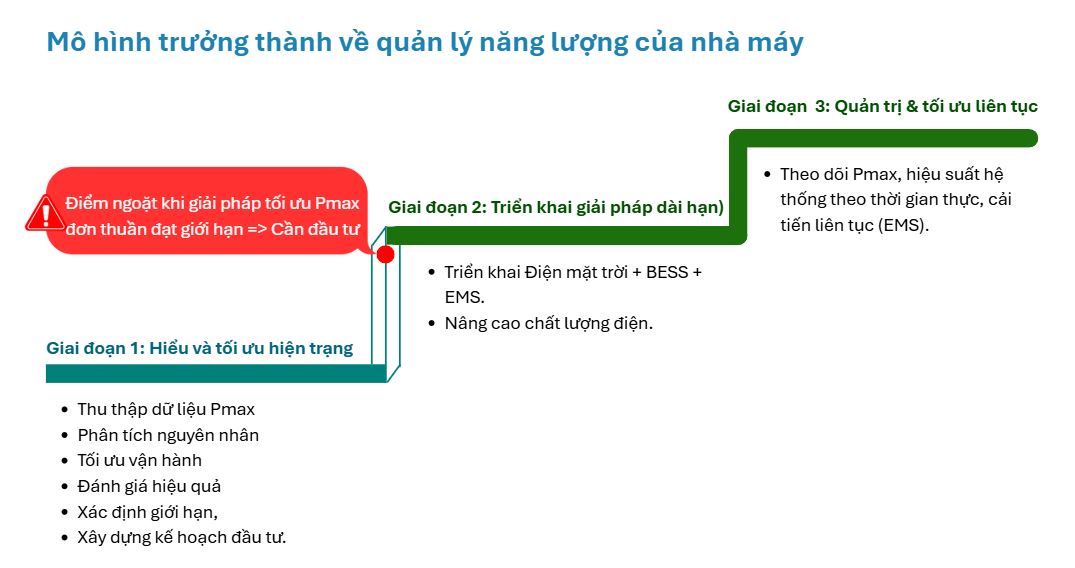
How does EMS help control Pmax?
In essence, EMS is more than just a display showing electricity consumption. EMS creates a process of data collection → connection → monitoring → analysis → alerts → optimization. Data can be collected from power meters, existing sensors, BMS/SCADA, Solar PV systems, and BESS, and then transferred to the EMS platform through an IoT connectivity layer and a cloud or local server. Based on this data, EMS helps businesses:
1. See Pmax in real time
Instead of only knowing Pmax after the billing period ends, businesses can monitor changes in power demand and identify when loads increase significantly. This provides a basis for detecting abnormal peak demand and taking proactive action.
2. Identify equipment or areas with high power demand
EMS can analyze data by area, system, or equipment. When a load increases abnormally, the data helps businesses identify the source of the problem instead of only looking at the total electricity consumption of the entire factory.
3. Monitor the relationship between Pmax and energy systems
EMS can integrate data from Solar PV and BESS on the same platform. This allows businesses to monitor solar power generation, the status of the energy storage system, and loads to evaluate how effectively different energy sources are working together.
4. Detect abnormalities and provide early alerts
When data is continuously monitored, the system can detect operational issues and send alerts to the responsible team, instead of waiting until a problem occurs or the electricity bill increases significantly.
EMS does not replace operational optimization. It makes optimization more accurate. EMS provides data and visibility into the system, enabling businesses to make more accurate operational decisions. For small and medium-sized factories, businesses can start with operational optimization or invest in Solar + BESS first. As the system becomes larger, EMS helps monitor investment performance, detect abnormalities, proactively control Pmax, and build a data foundation for ESG reporting and energy audits.
The 9-step Pmax control roadmap: from current-state optimization to continuous management
According to NSN, peak demand (Pmax) control should not be treated as a standalone project. Instead, it requires a 9-step roadmap divided into three stages.
Stage 1: Understand and optimize the current state
Businesses first need to understand how Pmax is formed, then test short-term operational optimization solutions for at least three months and measure the results. When these operational optimization solutions do not achieve the expected Pmax reduction, businesses can then move on to evaluating long-term investment solutions.
Stage 2: Implement long-term solutions
Depending on the current condition of the factory, businesses can implement solutions such as Solar + BESS + EMS and power quality improvement.
Stage 3: Continuous management and optimization
After the system is implemented, businesses continue to monitor Pmax and system performance in real time, evaluate the results, and continuously improve performance.
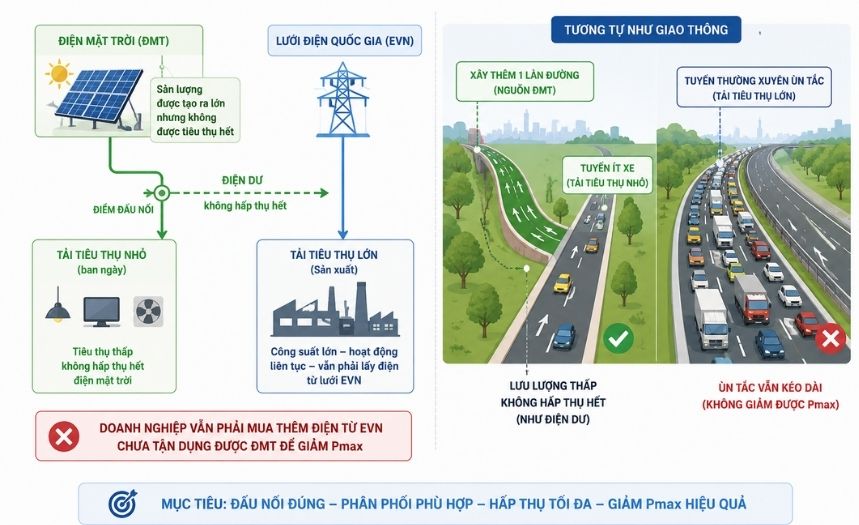
(*) To receive the detailed 9-step, 3-stage checklist, please contact NSN for further consultation.
Conclusion:
Through the three Webinars, NSN aims to provide businesses with a complete roadmap to proactively adapt to the Two-Component Electricity Pricing mechanism:
- Understand the impact of Pmax on electricity costs.
- Optimize operations to maximize solutions requiring little or no investment.
- Invest at the right time in suitable long-term solutions.
- Manage energy based on data to maintain sustainable performance throughout the operational lifecycle.
When the Two-Component Electricity Pricing mechanism is expected to be implemented from 2027, Pmax will no longer simply be a figure on the electricity bill. It will become a variable that businesses need to actively manage. The earlier a factory starts, the more time it has to understand its system, control Pmax, select the right solutions, and optimize costs before the new mechanism officially affects production operations. NSN is ready to accompany businesses from current-state assessment and Pmax control to the implementation of energy solutions and long-term effective energy management.
![[WBN 3 - Part 2]: Rooftop Solar + Bess: From Increasing Green Energy Use To Sustainable Pmax Control](/upload/tin-tuc/2025-ban-tin-doanh-nghiep/dien-2-thanh-phan/1785401074464-6914433568007851552-g8521094553282089876-93448f980574a926c283de0ecb35c37f-800x0.jpg)