


Solar Power on Existing Factory Roofs: How to Ensure Safety While Maximizing Output?

As businesses increasingly focus on optimizing energy costs and achieving ESG and Net Zero goals, rooftop solar power has become an attractive option for manufacturing facilities. However, for factories that have been operating for many years, the key question is no longer “Should we install solar power?” but rather “How can we install it safely and maximize its effectiveness on existing factory roofs? ”.
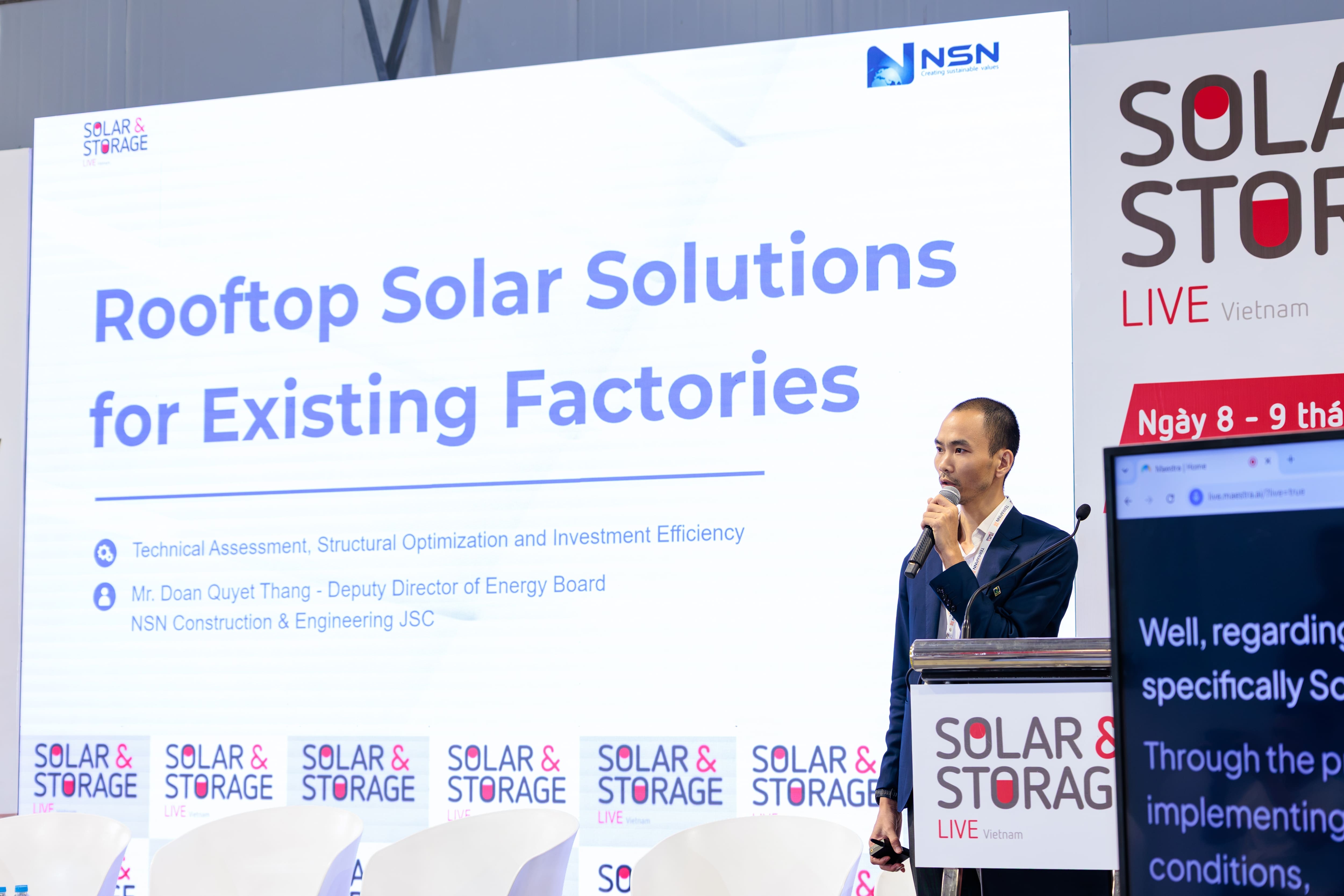
This was also the topic presented by Mr. Doan Quyet Thang, Deputy Director of the Energy Board at NSN Construction & Engineering JSC, at Solar & Storage Live Vietnam 2026 in his presentation titled “Installing Solar on Existing Roofs: How to Ensure Safety While Maximizing Output?” Drawing from extensive experience in delivering rooftop solar projects for FDI manufacturers, NSN shared practical insights to help businesses accurately assess the potential of their factory roofs before making investment decisions.
Rooftop Solar: Benefits Beyond Electricity Cost Savings
For manufacturers, factory roofs are valuable assets that are often underutilized. Converting rooftop space into a source of clean energy offers several tangible benefits. First, the economic benefit: Generating electricity on-site reduces dependence on grid power, helping businesses optimize operating costs while easing pressure on the national power system during peak demand periods. Second, the environmental benefit: Solar power helps reduce CO₂ emissions without requiring additional land, giving businesses an advantage in meeting increasingly stringent sustainability requirements from customers and global supply chains.
The Biggest Challenge Lies in the “Health” of Existing Factory Roofs
According to Mr. Doan Quyet Thang, the greatest concern is not the efficiency of the solar panels, but the actual condition of the roof structure.
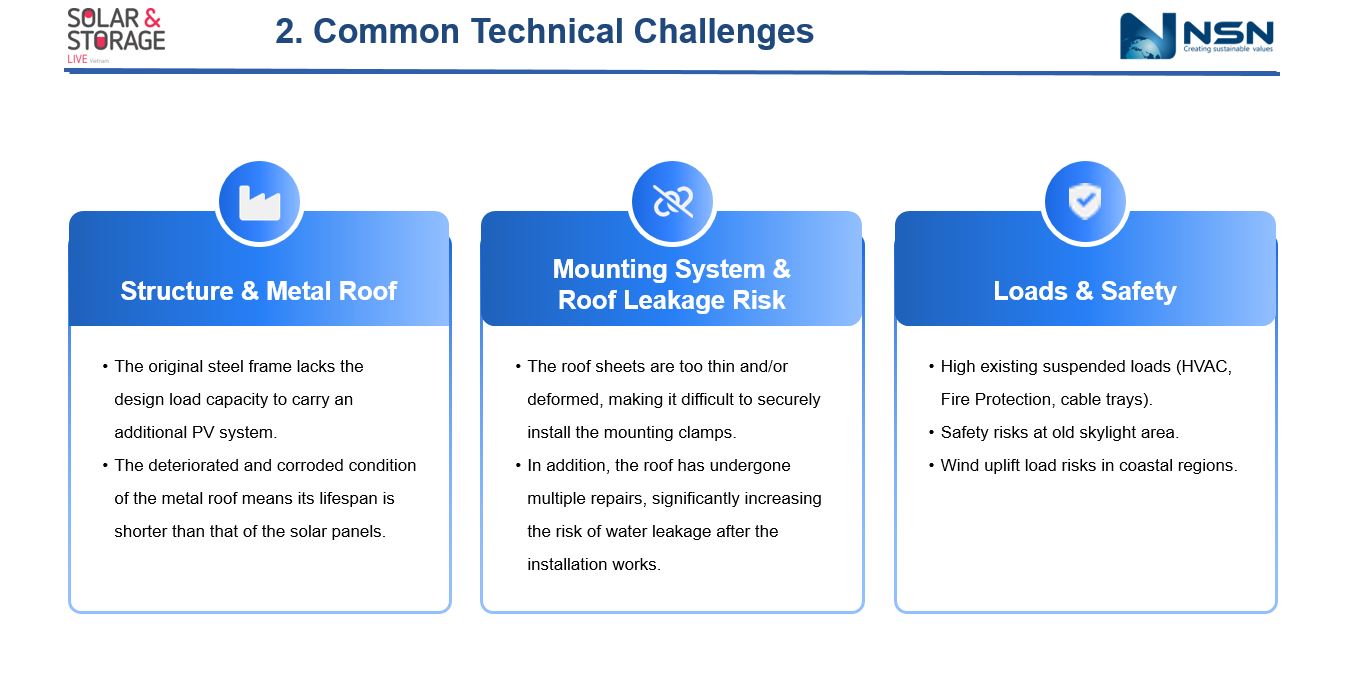
Most factories built many years ago were not originally designed to carry the additional load of a solar power system throughout about a 25-year operating lifecycle. Without a thorough assessment, businesses may face risks such as weakened steel structures, corroded or deteriorated roofing sheets, water leakage caused by installation work on roofs that have undergone multiple repairs, and reduced remaining load capacity due to existing HVAC systems, fire protection systems, and technical pipelines.
That is why NSN consistently recommends that businesses avoid relying solely on visual inspections. Instead, a quantitative structural assessment should be conducted before any investment decision is made.
The “Roof Health Check” Before Installing Solar Power
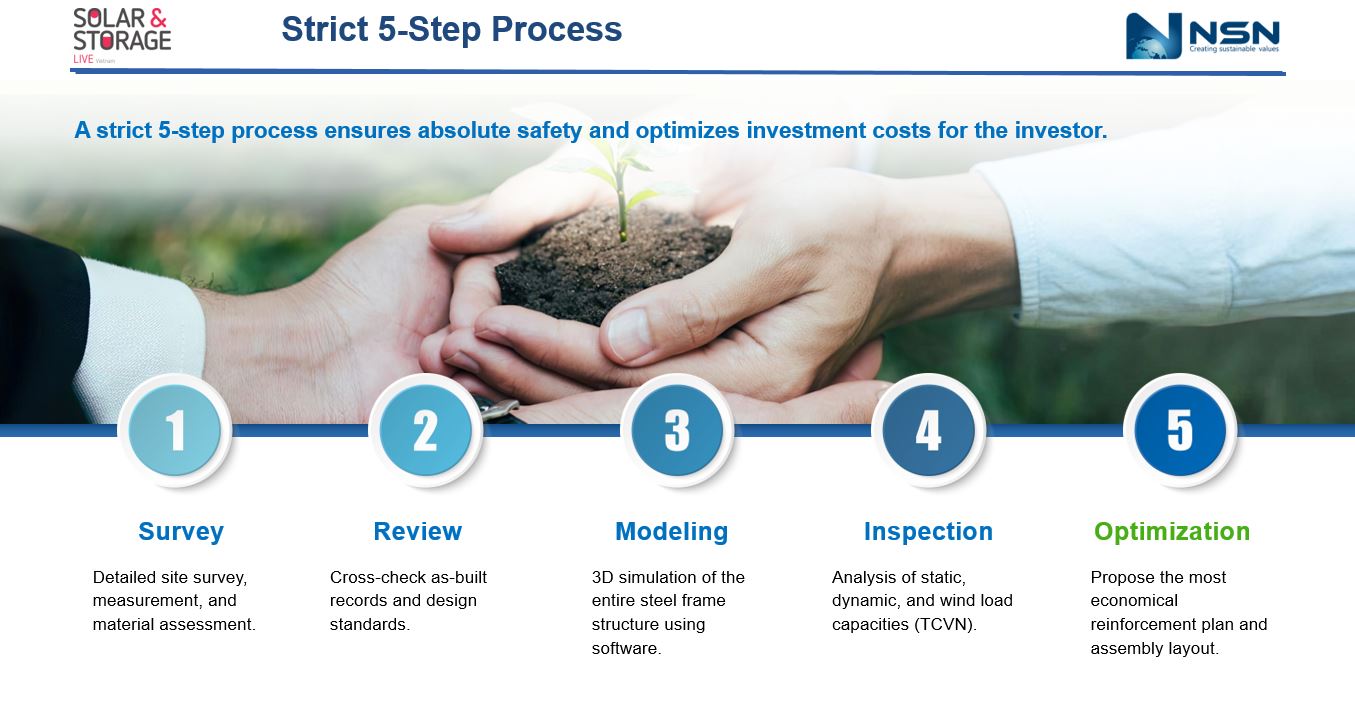
To ensure safety and optimize investment efficiency, NSN Construction & Engineering JSC applies a comprehensive five-step technical assessment process before proposing any solution. The process begins with an on-site survey using specialized equipment to measure roof thickness and assess corrosion levels. Engineers then compare the actual condition with the original design documents to identify any changes that have occurred during years of operation. The collected data is subsequently incorporated into a 3D structural model to analyze load-bearing capacity under the effects of weight, wind, and operational conditions. Based on these analyses, NSN develops suitable installation or reinforcement solutions that help businesses optimize costs while ensuring long-term safety.
Every Roof Requires a Different Solution
One of NSN’s distinguishing approaches is that no single solution is applied to every project. After the assessment, roof areas are classified according to their structural condition. Some areas are ready for immediate installation, some require localized reinforcement, while others should not be developed until structural issues are fully addressed. For roofs with load limitations, NSN also studies advanced technologies such as ultra-light solar panels, which significantly reduce the load imposed on the roof and minimize intervention to the existing structure. However, the choice of technology must always be evaluated on a project-by-project basis to ensure optimal investment performance.
Investment Efficiency Begins with Accurate Assessment
Based on NSN’s experience, the lowest investment cost does not necessarily mean the best solution. A solar project creates real value only when it balances investment cost, structural safety, power generation performance, and long-term operational stability.

With more than 23 years of experience in industrial construction and nearly a decade of developing renewable energy solutions, NSN Construction & Engineering JSC provides rooftop solar solutions specifically designed for existing factories. Through a rigorous technical assessment process, NSN helps businesses unlock the full potential of their factory roofs, minimize risks, and move toward the goal of “Creating sustainable values.”
If your company is considering rooftop solar for an existing factory, contact NSN’s expert team for a detailed assessment and tailored solution. Every factory presents a unique challenge, and the most effective solution always starts with an accurate technical evaluation.
![[WBN 03 - Part 03] EMS: Data-driven Pmax Control And Energy Management For Factories](/upload/tin-tuc/2025-ban-tin-doanh-nghiep/dien-2-thanh-phan/1785401074464-6914433568007851552-g8521094553282089876-93448f980574a926c283de0ecb35c37f-800x0.jpg)
