

[WBN 3 - Part 2]: Rooftop Solar + Bess: From Increasing Green Energy Use To Sustainable Pmax Control

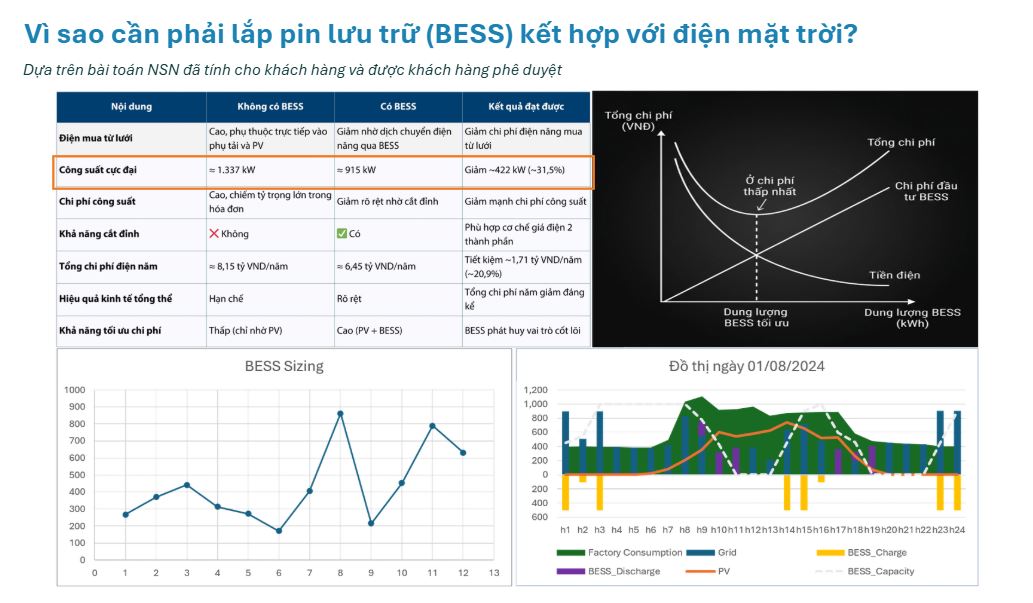
If improving power quality is the foundation, Rooftop Solar combined with a Battery Energy Storage System (BESS) is one of the most direct and effective solutions to help businesses increase their use of green energy while supporting peak demand (Pmax) control.
1. Why do many solar projects fall short of expectations?
Through its experience implementing projects for many FDI businesses, NSN has found that many businesses do not have sufficient technical expertise to assess technical solutions, rely heavily on consultants or contractors, and do not anticipate risks that may arise after several years of operation. Meanwhile, many energy-focused contractors tend to maximize the installed solar capacity without fully understanding the specific characteristics of manufacturing facilities and their load absorption capacity.
This can lead to two major issues.
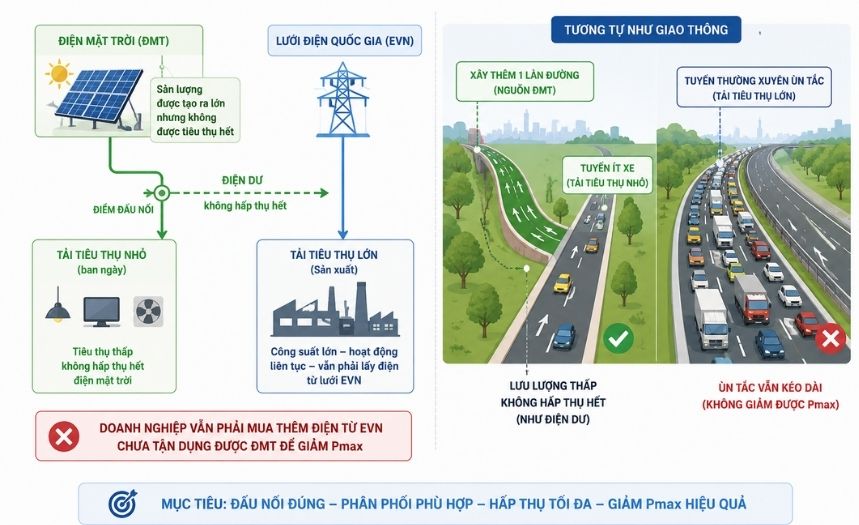
First, an unsuitable point of interconnection. Loads supplied by the solar system may not consume all the electricity generated, while high-consumption loads still need to draw electricity from the national grid. This is like building an additional lane but connecting it to a road with little traffic, while the road that is frequently congested remains unchanged. As a result, even after investing in a high-capacity solar system, businesses may still need to purchase additional electricity from EVN and may not be able to fully utilize solar power to support Pmax reduction.
Second, solar power can conflict with the factory's existing M&E system, leading to a lower power factor, directly causing energy losses, overloading transformers, and increasing electricity-related costs for the factory.
Therefore, installing a larger capacity does not necessarily mean achieving better efficiency. The installer needs to understand the factory before designing the energy solution.
With 23 years of experience working with industrial factories as a general contractor and 10 years of experience in renewable energy projects, NSN has built up extensive experience in assessing and surveying factories before designing energy solutions.
For the electrical system, NSN focuses on:
- Designing solutions that are compatible with the existing electrical infrastructure.
- Optimizing energy flows between the grid, solar power, and BESS.
- Minimizing conflicts with the existing M&E system.
- Creating a stronger foundation for effective Pmax control.
For operation:
- Flexible construction to minimize impact on production.
- Easy maintenance throughout the project lifecycle.
- Integration with the factory's energy system to support stable operation.
Therefore, NSN does not simply deploy solar and BESS systems. We design an integrated energy ecosystem that works seamlessly with the existing electrical infrastructure, helping factories optimize electricity costs and operate sustainably throughout a 20–25-year lifecycle.
2. Factories with old rooftops: safety first, optimization second
For factories that have been in operation for more than 10 years, installing rooftop solar raises several important questions: Is the roof suitable for installation? Will the additional load affect the roof structure? Will the solar system increase the risk of water leakage? These are valid concerns, especially for factories that have been operating for more than 10 years.
Instead of starting with the question, “How many MWp can be installed?”, NSN starts with: “How can the existing roof safely operate with the system over the next 20–25 years?”
NSN follows a five-step process, including:
- Surveying and assessing the current roof structure.
- Checking the roof's load-bearing capacity.
- Assessing corrosion levels and the risk of water leakage.
- Designing a solution suitable for the specific roof type and operating conditions.
- Determining the optimal installed capacity based on safety and long-term investment efficiency.
The goal is not to install the maximum number of solar panels, but to determine the optimal capacity that delivers investment efficiency while ensuring the safety of the factory throughout the system's lifecycle.
3. Two investment models for different business financial strategies
To suit the financial strategy of each business, NSN offers two implementation models.
Model 1: Business Investment (EPC): NSN handles the entire process from survey and design to construction, commissioning, and operation. Businesses have full control over their power supply, maximize long-term investment efficiency, and own a green asset that can support ESG reporting.
Model 2: DPPA/PPA: Suitable for businesses that are not ready to make an upfront investment. NSN provides electricity at a lower price than electricity purchased from EVN, with no CAPEX required and no impact on production cash flow, while still providing sufficient emissions reduction data for ESG reporting.
Whether a business prioritizes maximizing investment efficiency or optimizing production cash flow, it can choose a suitable model to gradually implement its green transition roadmap. And once Solar + BESS has been deployed, the next question is: “How can businesses know whether the system is actually operating effectively?” The answer will be explored in Part 3 of Webinar 03.
![[WBN 03 - Part 03] EMS: Data-driven Pmax Control And Energy Management For Factories](/upload/tin-tuc/2025-ban-tin-doanh-nghiep/dien-2-thanh-phan/1785401074464-6914433568007851552-g8521094553282089876-93448f980574a926c283de0ecb35c37f-800x0.jpg)