


[WBN 01_Part 3] How to assess your current electrical system to prepare for "two-component electricity pricing" mechanism?

Based on practical implementation experience, NSN Construction & Engineering JSC proposes a simple yet decisive 3-step process to help businesses systematically “check the health” of their electrical systems. This enables enterprises to proactively control maximum demand (Pmax) and turn electricity costs into a competitive advantage.

Step 1: Check the capability to monitor maximum demand (Pmax)
This is the most critical foundation, yet also a common weakness in many factories. Enterprises need to review:
- Can the existing electronic meters record Pmax?
- Can the system perform real-time load monitoring through AMR, EMS, or internal metering systems?
- Is data recorded at sufficiently detailed intervals (hour/minute) to identify peak demand?
If Pmax cannot yet be monitored accurately and continuously, upgrading or adding a metering system is necessary and should be prioritized immediately. From this, businesses can clearly identify where the peak load occurs, when it happens, and what factors cause it.
Step 2: Analyze data from the last 12 months
Once data is available, the next step is to turn it into meaningful insights. Enterprises should:
- Collect monthly electricity consumption and Pmax data
- Identify periods with abnormal peak demand
- Compare across months to recognize operational trends
It is essential to simulate electricity bills under the two-component pricing mechanism based on actual data. This step enables businesses to clearly understand the financial impact instead of relying on assumptions. From there, enterprises can determine whether they are in a favorable position or at risk of increased costs under the new mechanism.
Step 3: Evaluate equipment causing peak load
After identifying when Pmax occurs, the next question is: What is causing those peaks?"
Enterprises should:
- Inventory high-power equipment such as chillers, air compressors, electric furnaces, production meters, etc.
- Identify equipment that often operates simultaneously, leading to sudden load spikes
- Assess the contribution of each piece of equipment to the total peak demand
Based on this, specific solutions can be developed, such as the following:
- Load shifting across different operating time periods
- Adjusting equipment start-up schedules
- Optimizing operating capacity at each moment
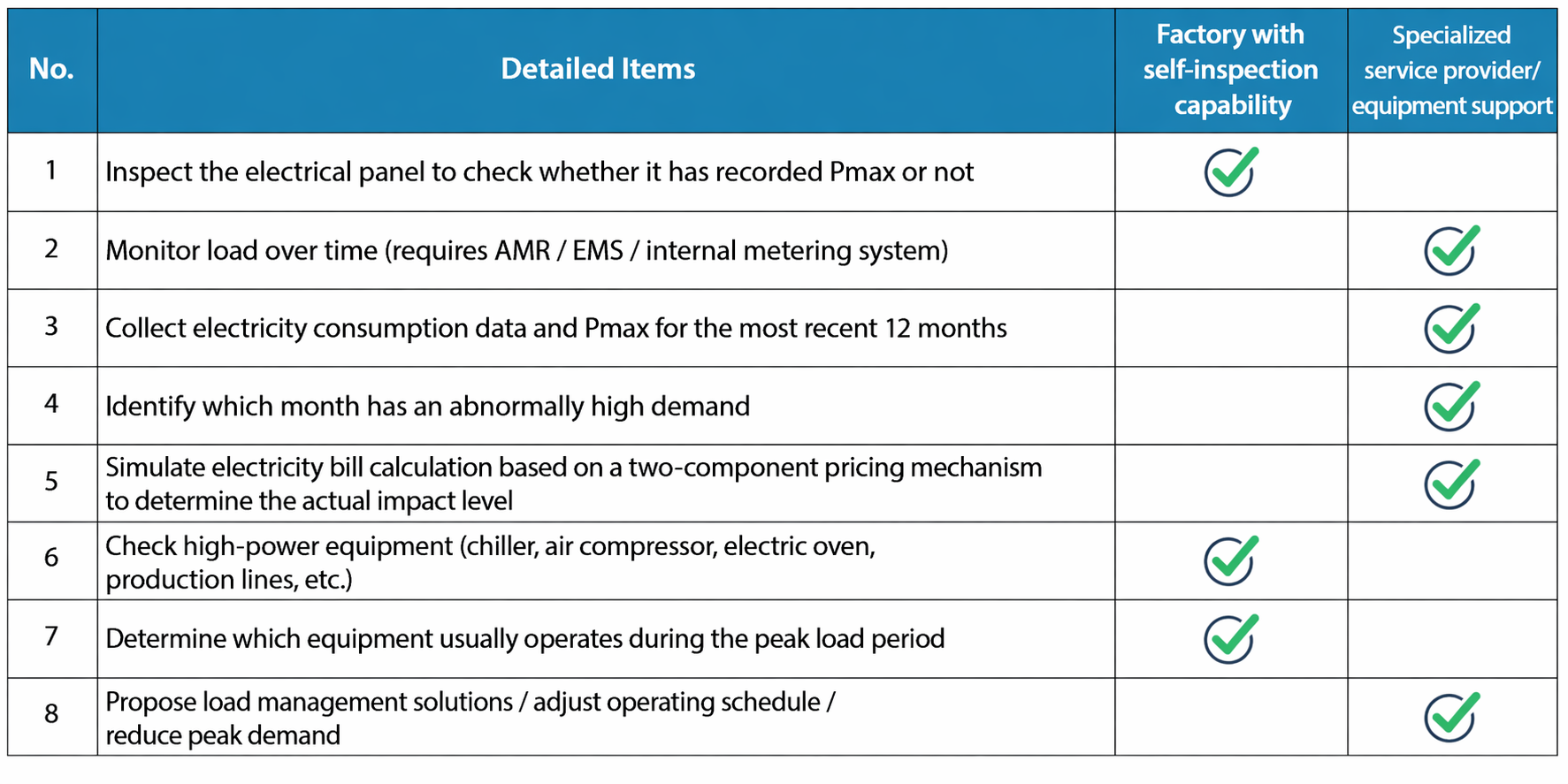
Summary of factory items that can be inspected in-house or by a specialized service provider
Two-component electricity pricing is not a complex challenge if businesses adopt the right approach from the beginning. Evaluating the electrical system not only helps enterprises quickly comply with new regulations but also opens up opportunities for sustainable cost optimization. With over 20 years of experience in industrial factory design and construction and 10 years in renewable energy, NSN partners with businesses to inspect, assess, improve, and create sustainable value.

![[WBN 03 - Part 03] EMS: Data-driven Pmax Control And Energy Management For Factories](/upload/tin-tuc/2025-ban-tin-doanh-nghiep/dien-2-thanh-phan/1785401074464-6914433568007851552-g8521094553282089876-93448f980574a926c283de0ecb35c37f-800x0.jpg)
