


[WBN 01_Part 2] How does Two-component electricity pricing mechanism impact factory electrical costs?

The two-component electricity pricing mechanism directly affects factory electrical costs through maximum demand (Pmax). NSN will clearly analyze these impacts through specific examples in the article below.
Not all businesses will experience increased electricity costs
When the two-component pricing mechanism is introduced, many businesses express concern about rising costs. However, based on NSN’s analysis and practical consulting experience with industrial factories, the impact of this mechanism is not uniform but depends directly on how each enterprise operates its electrical system.
Core change: Costs depend on Pmax
Under the new mechanism, electricity costs depend not only on energy consumption but also on maximum demand (Pmax). This means the power system is concerned with how much electricity a business consumes over the month and how much power is drawn at a specific point in time. NSN has observed that this is the factor that surprises many businesses when costs increase, even though total energy consumption remains almost unchanged.
Two typical groups of businesses:
Stable operation group – Reduced costs
Factories operating continuously in 3 shifts, with stable load profiles and minimal demand spikes, are typically the beneficiaries. Under the two-component pricing mechanism, the energy charge rate may decrease by 25–33% compared to the current level, and the resulting savings can fully offset the capacity charge. Based on preliminary calculations for several NSN-implemented projects, businesses in this group will record significant reductions in electricity costs after adopting the new mechanism.
Fluctuating load group – Increased costs
In contrast, businesses with unstable load profiles and frequent short-term demand spikes face higher risks. Even a single day with a sudden surge in demand can set the Pmax for the entire month. The enterprise must then pay that peak demand over all 30 days, even if operations remain at low levels for the remaining 29 days.
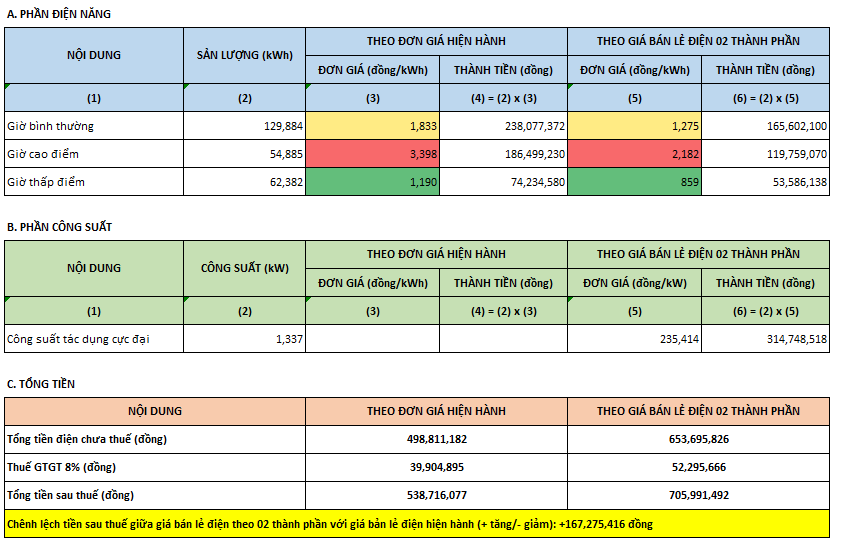
Comparison table of electricity pricing under the current mechanism and the two-component electricity pricing mechanism.
The new pricing mechanism creates a clear differentiation among businesses. Enterprises that effectively control their peak demand can optimize costs and enhance competitiveness, while those with poor demand control will bear significantly higher expenses. With over 20 years of experience in industrial factory design and construction and 10 years in renewable energy development, NSN can support businesses in fully understanding the mechanism, preparing early, and optimizing costs directly from their existing electrical systems.
![[WBN 03 - Part 03] EMS: Data-driven Pmax Control And Energy Management For Factories](/upload/tin-tuc/2025-ban-tin-doanh-nghiep/dien-2-thanh-phan/1785401074464-6914433568007851552-g8521094553282089876-93448f980574a926c283de0ecb35c37f-800x0.jpg)